The best GovCon ERP is a project-based system that supports DCAA-compliant accounting, indirect rate management, and federal cybersecurity standards such as CMMC 2.0 and FedRAMP Moderate. These capabilities ensure accurate cost tracking, audit readiness, and secure handling of contract data.
Generic ERP systems and small-business accounting tools cannot meet the cost accounting, compliance, and security requirements of government contracts.
GovCon firms require purpose-built ERP platforms designed to manage projects, contracts, and financials within a regulated environment.
Guide Contents
Learn how to choose the best GovCon ERP. Compare systems against DCAA, FAR, CAS, CMMC, and FedRAMP requirements to find the right fit for your firm.
Core Definition An ERP for government contractors unifies financial management, project accounting, contract management, time and expense, procurement, and reporting in a single system. It supports the full lifecycle of government work, from contract award through delivery and billing.
How a GovCon ERP Differs from Generic ERP
Project-Based Data Model
A GovCon ERP ties every transaction—labor, expenses, purchases, invoices, and indirect costs—to a contract, project, and task. This structure enables accurate tracking of costs, funding, and performance.
Built-In DCAA Compliance
A GovCon ERP enforces DCAA-compliant cost accounting, including segregation of direct and indirect costs, automated indirect rate calculations, exclusion of unallowable costs, and audit-ready timekeeping.
Support for Federal Contract Types
A GovCon ERP supports contract types such as Firm Fixed Price (FFP), Cost-Reimbursable (CPFF, CPIF, CPAF), Time-and-Materials (T&M), and IDIQ task orders, with appropriate billing and revenue recognition rules.
Why do GovCon firms need an industry-specific ERP?
GovCon firms need an industry-specific ERP to meet federal requirements for cost accounting, audit readiness, and cybersecurity, which generic ERP systems are not designed to support.
Federal Compliance Requirements Drive ERP Needs
Government contractors must comply with regulations including FAR, DFARS, CAS, and DCAA audit standards. Contractors handling Controlled Unclassified Information (CUI) must also meet NIST SP 800-171 and CMMC 2.0 requirements.
Generic ERP Systems Require Customization
Generic ERP systems and small-business accounting tools are not designed for GovCon compliance. Organizations often rely on customizations or third-party tools to meet requirements, which increases cost and complexity.
Audit Risk and System Limitations
Systems that rely on customization and external tools may struggle to meet audit requirements such as the SF 1408 Pre-Award Survey or Incurred Cost Submission reviews. This creates risk and increases audit preparation effort.
Purpose-Built GovCon ERP Reduces Risk
A purpose-built GovCon ERP embeds compliance into the system design, including cost accounting rules, audit trails, and security controls. This reduces reliance on workarounds and supports consistent, audit-ready operations.
What are the benefits of an ERP for government contractors?
Compliance
A GovCon ERP enforces DCAA-compliant timekeeping, segregates direct and indirect costs, automates indirect rate calculations, excludes unallowable costs, and generates audit-ready reports such as incurred cost submissions.
Contract Management
A GovCon ERP manages contract types such as FFP, Cost-Reimbursable, T&M, and IDIQ. It tracks contract values, modifications, funding, periods of performance, and links contracts to projects and tasks.
Project Accounting
A GovCon ERP provides real-time visibility into project budgets, actuals, burn rates, and profitability. It supports work breakdown structures, CLIN-based funding, and labor categories tied to rates.
Financial Management
A GovCon ERP automates billing, indirect cost allocation, and revenue recognition based on contract type. This reduces reliance on spreadsheets and improves accuracy.
Business Intelligence
A GovCon ERP delivers real-time dashboards for metrics such as project margin, utilization, backlog, cash flow, and indirect rate variance. This enables faster, data-driven decisions.
Security
A GovCon ERP supports secure environments aligned with FedRAMP and NIST SP 800-171 requirements. This helps firms protect Federal Contract Information (FCI) and Controlled Unclassified Information (CUI).
Resource Management
A GovCon ERP connects staffing plans, labor categories, and utilization forecasts to project demand. This improves resource planning and aligns workforce capacity with contract needs.
How do I choose the right ERP for my government contracting business?
Choose the right GovCon ERP by evaluating project-based design, compliance support, cybersecurity, contract handling, scalability, integrations, usability, and total cost of ownership.
Confirm the ERP is purpose-built for GovCon
Ask whether the system is designed specifically for government contractors or adapted from a generic ERP. Purpose-built systems support indirect rates, cost pools, contract types, and DCAA timekeeping natively.
Validate DCAA compliance capabilities
Confirm the ERP supports DFARS 252.242-7006 and SF 1408 requirements, including cost segregation, contract-level cost tracking, indirect rate allocation, and compliant timekeeping processes.
Assess cybersecurity and CMMC readiness
Verify the ERP supports NIST SP 800-171 controls and operates in a FedRAMP Moderate Authorized or Equivalent environment if handling CUI.
Verify support for federal contract types
Ensure the system supports FFP, Cost-Reimbursable, and T&M contracts, including billing, revenue recognition, funding, and contract modifications.
Evaluate scalability
Confirm the ERP scales across users, entities, and acquisitions, and supports multi-entity structures with consolidated reporting.
Examine integrations and ecosystem
Assess integration with payroll, HRIS, CRM, and other systems. Look for prebuilt integrations and a connected GovCon ecosystem.
Evaluate usability and support
Review ease of use, implementation approach, and customer support. Validate with demos, customer references, and independent reviews.
Calculate total cost of ownership
Compare five-year costs including licensing, implementation, integrations, administration, and compliance overhead to understand the full investment.
Why choose Unanet ERP GovCon?
Unanet ERP GovCon is a project-based ERP built specifically for government contractors that combines compliance, project management, and financials in a single integrated platform.
Purpose-Built for Government Contractors
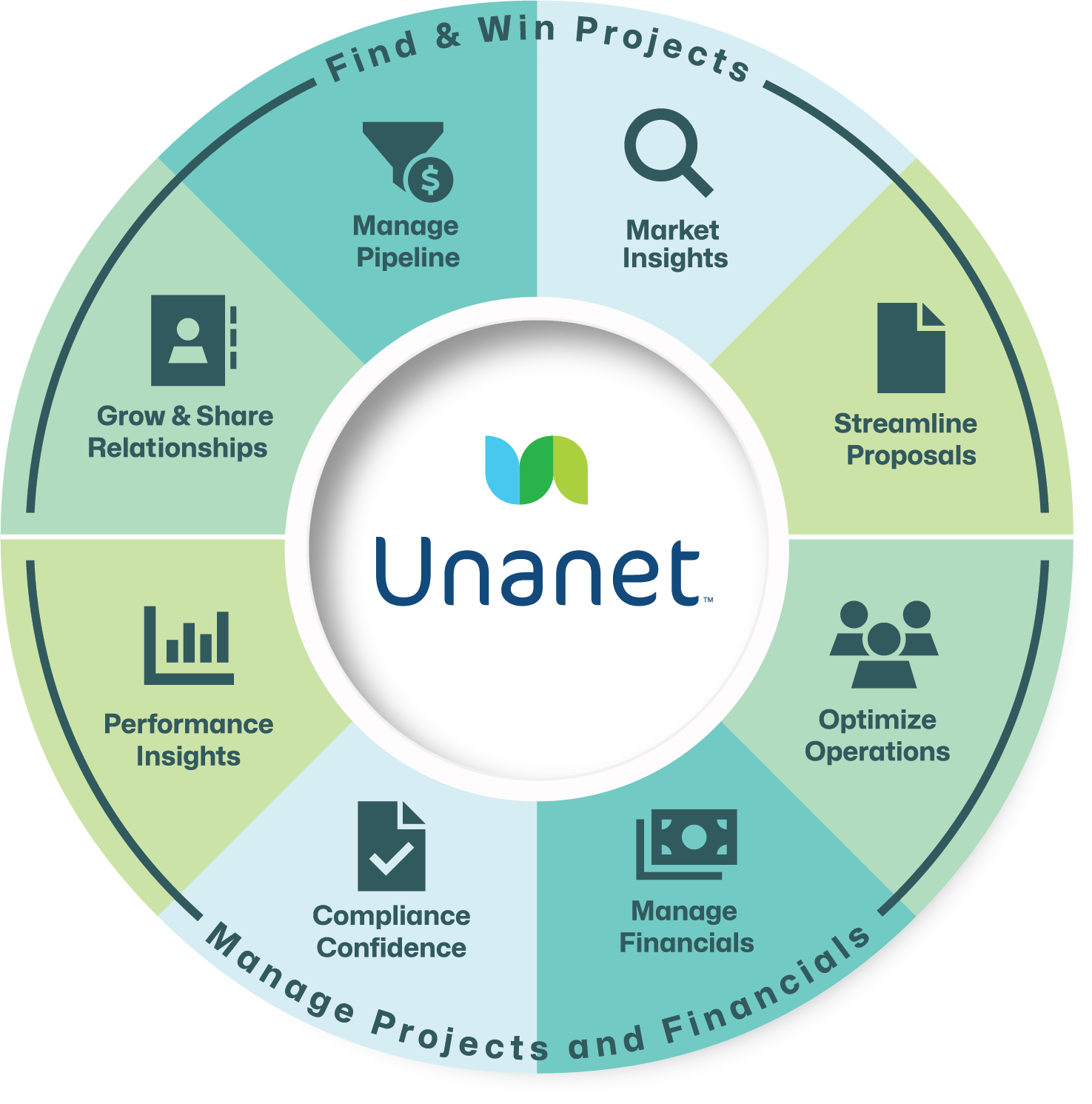
Unanet ERP GovCon is designed specifically for GovCon firms and supports project management, contract management, time and expense, financials, indirect rate management, and analytics in one system. This reduces complexity and eliminates the need for disconnected tools.
Built-In Compliance and Security
Unanet ERP GovCon supports DCAA-compliant accounting, FAR and DFARS requirements, CAS, and NIST SP 800-171 controls. It also operates in a FedRAMP Moderate Equivalent environment validated by an accredited 3PAO, supporting CMMC Level 2 readiness.
Real-Time Visibility and Control
Unanet ERP GovCon provides real-time visibility into project performance, indirect rates, and financial metrics. Teams can manage projects, monitor profitability, and maintain audit-ready data without relying on spreadsheets.
Single Integrated Platform
Unanet ERP GovCon uses a unified data model that connects projects, contracts, financials, and compliance. This creates a single source of truth and reduces administrative overhead.
Evaluate Unanet ERP GovCon
Evaluate Unanet ERP GovCon against your current system or shortlist to see how it supports compliance, visibility, and scalability.
We started seeing benefits so soon after implementing Unanet. Everything has been super smooth. Unanet’s made my life so much easier.
Frequently asked questions
A GovCon ERP is a project-based system that enforces federal cost accounting rules, including direct and indirect cost segregation, indirect rate calculations, and DCAA-compliant timekeeping. It also supports contract-based billing for FFP, Cost-Reimbursable, and T&M work, while standard ERPs require customization to meet these requirements.
QuickBooks is acceptable for early-stage government contractors with simple, firm fixed-price work. As contractors take on cost-reimbursable or T&M contracts or require DCAA-compliant timekeeping, QuickBooks cannot support cost segregation, indirect rates, or audit-ready reporting.
You need a FedRAMP Moderate Authorized or Equivalent ERP if your organization processes, stores, or transmits Controlled Unclassified Information (CUI). This supports CMMC Level 2 requirements. If you only handle Federal Contract Information (FCI), FedRAMP may not be required, but NIST SP 800-171 controls still apply.
A GovCon ERP implementation typically takes 3–6 months for mid-sized contractors, depending on data complexity, integrations, and system design. Smaller organizations may implement faster, while larger or more complex environments may require additional time for data migration, configuration, and testing.
FAR governs which costs are allowable on government contracts, while CAS governs how costs are measured, accumulated, and allocated. Your ERP must support FAR for all federal contracts and CAS for covered contracts, including cost segregation and automated indirect rate calculations.
A project-based GovCon ERP can handle both federal and commercial contracts by using a unified structure for projects, financials, and indirect rates. These systems support fixed-price and T&M work across both environments, while most commercial ERP systems cannot meet federal cost accounting and compliance requirements.
A GovCon ERP prepares you for a DCAA audit by maintaining complete audit trails, enforcing direct and indirect cost segregation, and generating audit-ready reports such as incurred cost submissions. This supports continuous audit readiness by keeping financial data, labor records, and supporting documentation organized and compliant.
Allow Functionality Cookies
Your privacy settings have disabled the use of functionality cookies. Please enable them to watch videos.
Allow Functionality Cookies
Your privacy settings have disabled the use of functionality cookies. Please enable them to listen to podcasts.