What ‘data-driven’ really means in AEC
Most AEC firms consider themselves data-driven, and many are on the right path. Here’s how firms can build on what they already have to improve decisions.


AI in AEC has reached an interesting point.
The novelty is wearing off.
Most of the firms I talk with are no longer asking whether they should experiment with artificial intelligence. They already are. People are using ChatGPT. They're using Microsoft Copilot. They're testing purpose-built tools. They're exploring AI inside the software they already use.
What I see much less frequently is a coordinated strategy for what AI should actually do for the business.
That distinction matters.
According to the 2026 AEC Inspire Report, AI adoption across AEC firms has climbed to 75%. But only 29% of firms report high confidence in the underlying data feeding those tools. At the same time, 71% of firms are submitting more proposals, yet average win rates remain around 50%.
Those numbers capture something important about this moment:
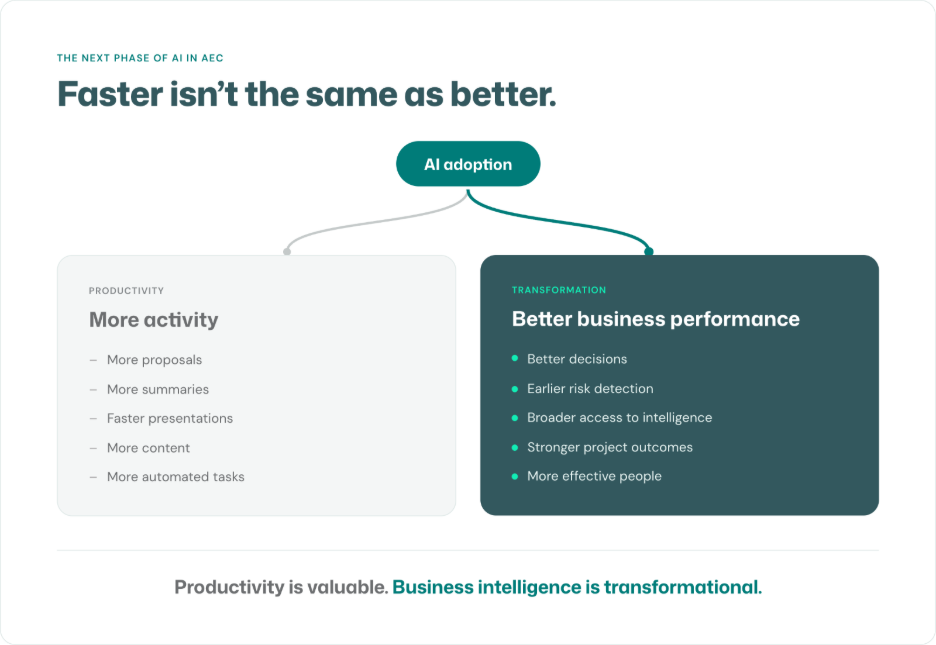
AI can make an AEC firm faster without necessarily making it better.
The next phase of AI adoption needs to be less about how much we can generate, automate, or summarize—and much more about whether AI is improving the decisions and processes that actually drive the business.
I spoke with a CFO recently who is using ChatGPT to help prepare presentations for the firm's board.
It's a genuinely useful idea. AI helps organize the presentation, analyze the firm's financial position, anticipate questions board members may ask, and prepare responses. The CFO gets an important task done faster and perhaps does it better.
But think about what hasn't changed.
That financial intelligence hasn't suddenly become available to the division leader trying to understand the business. It hasn't reached a project manager who needs to make a decision today. It hasn't created some new ability for people across the organization to understand performance and act on it.
The CFO has become more productive.
The firm has not necessarily become more intelligent.
There is nothing wrong with the first outcome. Personal productivity will remain a valuable part of AI.
But I think the second outcome is where the transformational opportunity lies.
For years, AEC firms have invested heavily in systems of record.
Those systems contain enormous amounts of useful information: financial performance, WIP, backlog, project budgets, schedules, staffing, pipeline, client relationships, proposals, time and expense, and more.
The problem has rarely been that the information doesn't exist.
The problem is getting the right pieces of it to the right person, in a form they can understand, at the moment they need to make a decision.
Historically, we solved that problem with reports.
A CFO might receive a financial report. An executive gets a dashboard. A project manager asks finance for project data. Operations exports backlog and staffing information into a spreadsheet.
And then the real questions begin.
Why did this number change?
Which projects caused it?
Is this an anomaly or a trend?
Which clients are most profitable?
Do we have enough capacity to deliver the work in our pipeline?
What happens to the forecast if this pursuit slips by 60 days?
Which projects should I be worried about right now?
That's the part our traditional systems have struggled with.
We've been able to produce the report. We haven't been able to easily ask the thousand questions that follow the report.
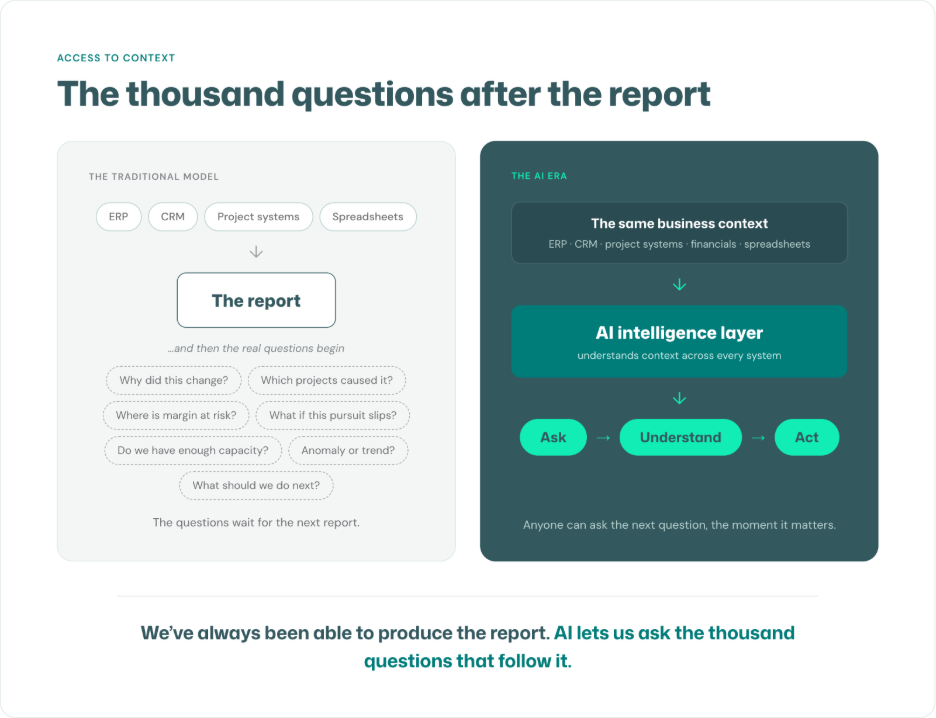
AI changes that.
I believe one of the most important shifts ahead for AEC will be the emergence of a new center of gravity for the business: a layer of intelligence capable of understanding context across multiple systems and allowing people throughout the firm to interact with that context naturally.
For an executive, that might mean asking where the financial forecast is most exposed.
For a project manager, it might mean understanding why margin is drifting.
For an employee entering a timesheet, it might be as simple as asking, "How many hours did I spend on this project last week?"
The sophistication of the question isn't what matters.
The democratization of the answer does.
That direction also reflects a problem AEC firms have been wrestling with for years: executives, finance leaders, operations teams, and PMs may all need trusted business information, but access to that information is frequently fragmented, delayed, or dependent on someone else assembling it.
Yes—but I think even that question undersells the opportunity.
More visibility is helpful. Earlier understanding is better.
AEC firms already have ways to see project profitability. The challenge is that by the time a financial result appears in a report, the operational decisions that created it may have happened weeks or months earlier.
AI creates the possibility of putting the pieces together sooner.
Imagine a project that still looks reasonably healthy financially, but labor is being consumed faster than planned. A milestone has slipped. Senior people are spending more time on the job than expected. Client questions are beginning to suggest scope expansion.
Individually, none of those signals may trigger an alarm.
Together, they tell a story.
The valuable AI isn't the one that gives the PM another dashboard.
It's the one that recognizes the emerging pattern and says: this deserves your attention, and here's why.
That is a very different definition of project profitability visibility. It's less about looking at the number and more about understanding what is likely to move the number next.
This is also why some of the least glamorous AI applications may ultimately create the most value. Zweig Group recently made a similar observation: while much of the attention goes to AI in design, significant near-term business opportunity exists in areas such as planning and operations where firms have persistent pain and more measurable business outcomes.
This is another area where the technology becomes interesting very quickly.
Project managers sit at the center of an enormous amount of information.
They need to understand scope, schedule, fee, staffing, client expectations, deliverables, financial performance, risks, changes, and the constant flow of communication surrounding a project.
The problem isn't that PMs lack judgment.
It's that their judgment is constrained by how much context they can realistically assemble and process.
A few weeks ago, I was walking an AEC firm through an AI workflow that could evaluate information from its business systems, analyze a project, and proactively send the PM an email with what deserved attention.
The PM wouldn't have to run a report.
They wouldn't even have to log into another application.
The intelligence could arrive in the same place they already communicate with the rest of their organization. The PM could respond to the AI from that email thread, ask follow-up questions, prepare for an upcoming client conversation, and investigate what was changing.
You could see the light bulbs going on.
And what was interesting wasn't the automation itself.
It was what the automation gave back to the PM: reach.
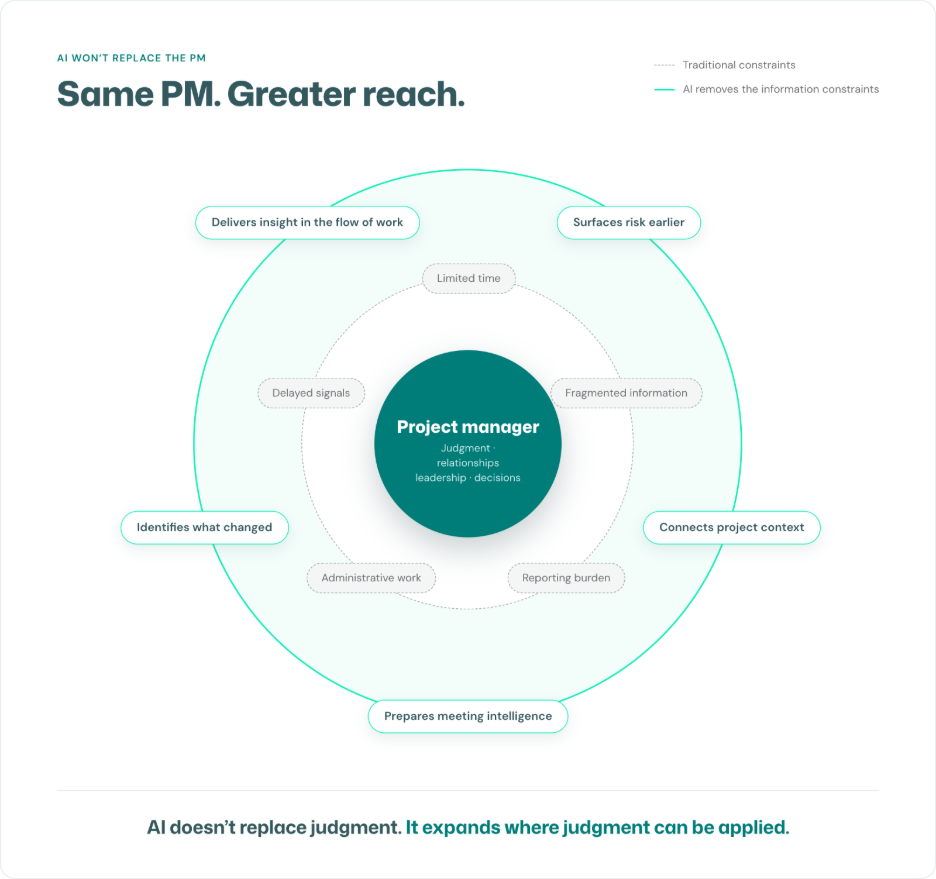
This is why I'm skeptical that AI will replace the AEC project manager.
I think the more interesting future is almost the opposite.
AI can fill some of the information gaps and administrative barriers that have limited PM effectiveness for years. It can help an experienced project manager see more, prepare faster, identify problems sooner, and bring better context into client and team conversations.
It doesn't eliminate the importance of judgment.
It amplifies the influence of the person exercising it.
That distinction matters in an industry where project leadership is still fundamentally about navigating complexity, relationships, uncertainty, and professional responsibility. Zweig's research on current PM expectations similarly emphasizes leadership, early identification of issues, and clarity under pressure—not simply task administration.
The same principle applies to financial workflows like WIP.
AI can certainly help someone summarize a WIP report.
That's useful.
But imagine instead that the system could help a finance leader investigate why WIP changed, identify the projects driving the variance, connect those projects to operational signals, and then bring the relevant project leaders into the conversation.
Or imagine giving a project leader enough governed access to answer many of those questions directly without asking finance to build another custom report.
Now AI is beginning to change the operating model.
Finance isn't simply producing reports faster. It can spend more of its time interpreting the business and less time serving as the human translation layer between systems and everyone who needs an answer.
That's an important evolution for AEC firms where finance teams have historically become reporting gatekeepers and PMs often need more timely, actionable information than traditional reporting processes provide.
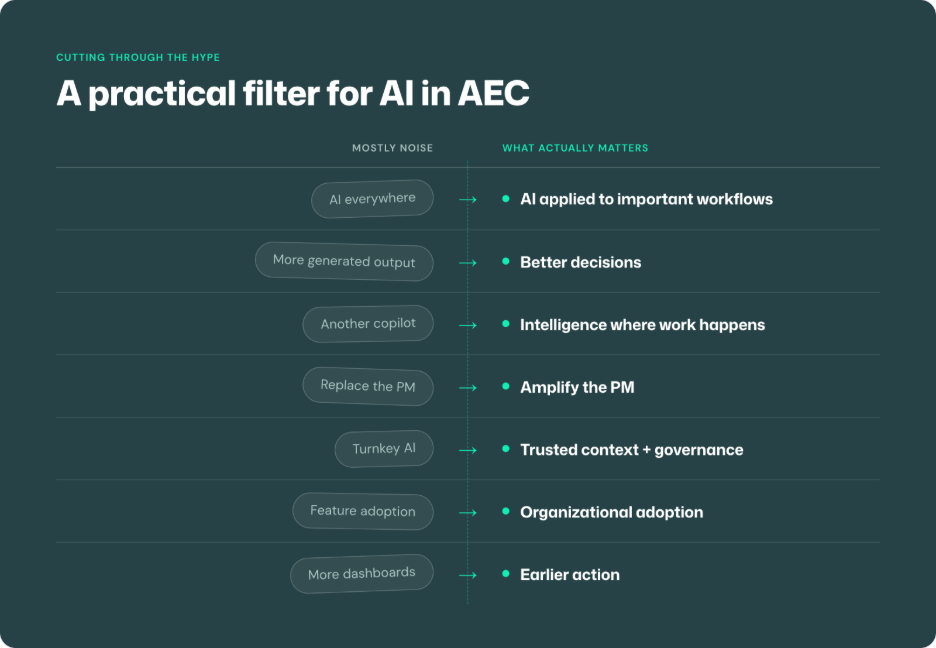
The biggest misconception, in my view, is the idea that AI's primary value comes from replacing people.
Will AI replace your project managers?
No.
Will it change how project managers work and potentially allow a strong PM to exert influence across more work?
Absolutely.
The second misconception is the idea of effortless, turnkey AI: connect a tool and suddenly the firm has intelligence.
That isn't how this works.
AI is only as useful as the context it has access to and the degree to which that context can be trusted.
That doesn't mean every AEC firm needs to complete a perfect, multiyear data transformation before it can benefit from AI. In fact, AI can be remarkably effective at working across disparate sources and helping firms make sense of information that previously lived in different places.
But there is a difference between fragmented data and nonexistent, inaccurate, or poorly governed data.
AI cannot reliably infer a business reality that the organization itself has never captured.
And when context is incomplete, firms have to guard against another familiar AI problem: the system confidently filling in the gaps itself.
ACEC's 2026 research on AI risk reinforces this point. Its findings emphasize that reliable AI adoption depends not only on the technology, but on data governance, professional review, accountability, workforce readiness, and organizational leadership. It also makes clear that professional responsibility remains with the human—even as AI becomes more capable.
This brings me to what may be the least technical—and most important—part of the conversation.
Two firms could have access to exactly the same AI capabilities and get dramatically different results.
Why?
Because one has a culture that embraces experimentation. Leaders communicate what they're trying to accomplish. Employees trust the process enough to change how they work. The firm has reasonable governance. Teams understand when to trust AI, when to question it, and where human judgment remains essential.
The other buys several tools, launches a few pilots, lets individual departments experiment independently, and waits for transformation to happen.
I don't think this difference gets enough attention.
The benefit a firm receives from AI will be directly connected to its ability to cultivate change and adoption.
That is why AI strategy cannot simply be an IT strategy.
And it can't simply be a software purchasing strategy.
It is becoming an operating-model question.
PSMJ's own framing around AI in AEC (shout out to an amazing conference) has increasingly emphasized moving from hype toward concrete ROI and actionable use cases rather than adopting emerging technology for its own sake.
When an AEC leader looks at an AI use case, I would ask five questions:
Those questions are much less exciting than many of the AI headlines.
I think that's precisely why they matter.
There is a tremendous amount to be optimistic about.
I believe AI will fundamentally change the way AEC firms understand their businesses, manage projects, allocate resources, pursue work, and make decisions.
But the transformation won't come simply because everyone gets access to an AI assistant.
It will come when firms connect AI to the context of the business and put that intelligence in the hands of the people who can do something with it.
When a PM can see risk before it becomes margin erosion.
When a CFO's understanding of the business doesn't stop at the CFO.
When an executive can interrogate a forecast rather than simply receive it.
When a seller-doer can get the context they need without spending half the day maintaining a system.
When experienced people can apply their judgment across more of the organization than was previously possible.
That's when AI stops being an interesting productivity tool.
It starts becoming a new way to run an AEC firm.