When Defense Secretary Pete Hegseth announced that the Pentagon would review every 8(a) sole-source contract above $20 million, he was describing a population most contractors didn’t immediately recognize. There is a reason the threshold matters, and it has everything to do with who can actually win an award that large.
The answer is narrow. As former GSA Administrator Emily Murphy put it in a recent Federal News Network interview, “The only companies getting $20 million sole source awards through the 8(a) program are Alaska Native corporations, Native Hawaiian organizations, Tribally owned organizations.” In other words, the $20 million floor is not just a neutral dollar figure. In practice, it concentrates the review on entity-owned 8(a) firms. For ANCs, NHOs, and Tribally owned 8(a) companies, this review is not adjacent; it directly affects the contracting model they rely on.
This post breaks down the mechanics of the sole-source threshold, why entity-owned firms are uniquely exposed, and the documentation disciplines that separate a defensible award from a vulnerable one.
The mechanics: how the 8(a) sole-source threshold actually works
Most 8(a) firms cannot receive a $20 million sole-source award at all. There is a cap on sole-source 8(a) awards, and for individually owned firms it sits well below that level, roughly $5.5 million for services and $8.5 million for manufacturing. Murphy made the point directly: the sole-source cap “depends on whether it’s for goods or services. But it’s less than half of that amount.”
Entity-owned 8(a) firms play by different rules. Tribally owned companies, ANCs, and NHOs do not carry the same affiliation restrictions or management restrictions that traditional 8(a) firms do. Congress raised the tribal sole-source ceiling to $100 million in 2020, far above the limit that applies to individually owned firms. These are not loopholes.
They are statutory authorities granted because of the federal government's trust and treaty obligations to Native nations, not because of a diversity preference.
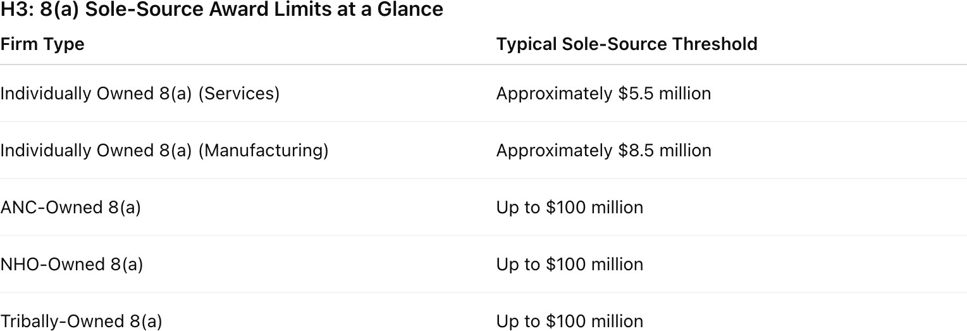
So, when the Pentagon scopes a review to contracts above $20 million, the math is direct. Individually owned 8(a) firms structurally cannot hold awards at that size, which means the entire reviewable population is entity-owned. The focus on entity-owned contracting is built into the threshold itself.
Why this matters now
The Pentagon review is occurring alongside a broader SBA audit of 8(a) program participants and a Treasury review of preference-based contracting programs. Together, these reviews represent the most significant scrutiny of entity-owned 8(a) contracting in years. Organizations that can quickly demonstrate self-performance, subcontracting compliance, and financial discipline will be better positioned to respond to agency inquiries and maintain contract momentum.
Why entity-owned firms face greater scrutiny
The scrutiny is not just statistical. It is structural, and it shows up in three ways.
The threshold puts entity-owned firms at the center of the review. Hegseth said the Pentagon would focus on awards above $20 million and examine whether contracts contribute to military readiness and whether the 8(a) firm is performing the work itself rather than passing it through to larger consulting firms. Murphy noted the same signal in the announcement, observing that the focus on the $20 million tier meant the Pentagon “seemed to be looking at the larger 8(a) companies, the ones that have taken on more and more of this work.”
The reviews overlap on the same firms. The Pentagon’s line-by-line review sits on top of a broader SBA audit that began months earlier, plus a Treasury review of preference-based contracting. Each is its own evidentiary demand. For a tribal enterprise that holds multiple 8(a) companies under a single parent, the burden compounds: every subsidiary has its own certification, its own records, and its own exposure. The same authorities that let tribal enterprises scale, the ability to hold multiple 8(a)s under one parent, are precisely what multiply the audit footprint.
The central question is pass-through. Both the Pentagon and SBA reviews orbit the same issue: limitation on subcontracting. Congress shifted the test years ago from a hard-to-audit cost basis to a dollars-based rule, where a small business receiving a set-aside award must keep at least 50 percent of the awarded dollars with itself and similarly situated firms. Regulators can now audit compliance far more easily than before. If the government concludes that an 8(a) firm is functioning as a pass-through to a large prime, the award becomes vulnerable.
How to defend your awards
Murphy’s read on legitimate firms is reassuring, with a caveat. “If you’re following the rules, this shouldn’t itself be a fundamental challenge,” she said, while noting that award freezes and pipeline disruptions can still hurt firms that did nothing wrong. The firms that come through cleanly will be the ones that can prove compliance on demand, not just assert it.
Three disciplines matter most.
H3: Documented self-performance. The core question reviewers are asking is whether the 8(a) entity performs the primary and vital work itself. That requires evidence: DCAA-ready timekeeping with audit trails by employee, project, and task, plus mentor-protégé records that show the protégé entity actually completing primary-and-vital tasks. When a reviewer asks who did the work, the answer should be a report, not a narrative.
H3: Subcontracting limits. Track the dollar split between your firm, similarly situated firms, and everyone else, on every contract. Murphy’s warning extends beyond the 8(a) world: pass-through risk exists for all small business contracts, so any firm should be documenting limitation-on-subcontracting compliance as a matter of routine. The point is to be able to demonstrate the 50 percent test rather than reconstruct it under a deadline.
H3: Indirect rate discipline. The SBA audit is examining owner withdrawals, benefit distributions to Native communities, and financial records going back three years. Defensible, well-documented indirect rates and a clean record of community-benefit distributions are what distinguish a tribal 8(a) from any other participant, and that documentation belongs in proposal narratives, capability statements, and audit response packages, not in a folder you assemble after a letter arrives.
The bottom line
The $20 million threshold is doing exactly what it was scoped to do. It draws a line that only entity-owned firms sit above, which means ANCs, NHOs, and Tribally owned 8(a) companies are carrying the weight of this oversight wave whether or not their contracts are flawless. The statutory authorities that support entity-owned 8(a) contracting (higher thresholds and the ability to operate multiple subsidiaries) are also the features that concentrate review activity.
Compliance was always the rule. What has changed is the burden of proof. Firms that can connect timekeeping, subcontracting, indirect rates, and financial records in one defensible view will be better positioned to respond quickly when reviewers ask. For a deeper look at the broader review, see our breakdown of the 2026 Pentagon line-by-line review of $20M+ 8(a) sole-source contracts and the companion analysis of what the 2026 SBA 8(a) audit means for tribal contractors.
Key Takeaways
- Only entity-owned 8(a) firms can receive sole-source awards above $20 million.
- The Pentagon's review is focused on contracts that fall almost exclusively within ANC, NHO, and Tribally owned contracting structures.
- Self-performance and limitation-on-subcontracting compliance are central review criteria.
- Organizations should maintain DCAA-ready documentation and defensible financial records.
- The burden is no longer just compliance—it is proving compliance quickly.
Frequently asked questions
What is the 8(a) sole-source contract threshold for tribal firms? Individually owned 8(a) firms are capped at roughly $5.5 million for services and $8.5 million for manufacturing on sole-source awards. Tribally owned firms, Alaska Native Corporations (ANCs), and Native Hawaiian Organizations (NHOs) operate under a much higher ceiling, which Congress raised to $100 million in 2020. That gap is why a $20 million award can only go to an entity-owned 8(a).
Why does the $20 million threshold target tribal contractors specifically? Because individually owned 8(a) firms structurally cannot hold sole-source awards that large. When the Pentagon scoped its review to contracts above $20 million, the entire reviewable population was entity-owned: Tribally owned companies, ANCs, and NHOs. As former GSA Administrator Emily Murphy put it, “The only companies getting $20 million sole source awards through the 8(a) program are Alaska Native corporations, Native Hawaiian organizations, Tribally owned organizations.”
What are the Pentagon and SBA actually reviewing? The Pentagon is conducting a line-by-line review of every 8(a) sole-source contract above $20 million, focused on whether the work supports military readiness and whether the 8(a) firm performs the work itself rather than passing it through to a larger prime. A parallel SBA audit is examining subcontracting limits, mentor-protégé performance, owner withdrawals, benefit distributions to Native communities, and three years of financial records, and Treasury has opened its own review of preference-based contracting.
Why are tribal enterprises with multiple 8(a) subsidiaries more exposed? The authorities that let a tribal enterprise hold multiple 8(a) companies under a single parent also multiply the audit footprint. Each subsidiary carries its own certification, its own records, and its own exposure, so a single enterprise can face several parallel record submissions inside the same window.
How can ANCs, NHOs, and Tribally owned firms defend their awards? Focus on three disciplines: documented self-performance through DCAA-ready timekeeping and mentor-protégé records that show primary-and-vital work completed by the protégé entity; subcontracting-limit tracking that demonstrates the 50 percent dollar test on every contract; and indirect rate discipline, including defensible rates and a clean record of community-benefit distributions. The goal is to prove compliance on demand rather than reconstruct it after a compliance letter arrives.
Are 8(a) sole-source awards over $20 million still allowed? Yes. The Pentagon review does not eliminate the authority for ANC-owned, NHO-owned, and Tribally owned 8(a) firms to receive sole-source awards above $20 million. The review focuses on evaluating existing contracts and compliance with performance and subcontracting requirements.